Best for combined body and habit tracking: Hume Pod 2.0. Best for weight alone: a connected weight-only scale. Best for standalone composition estimates: a foot-only body-composition smart scale. Finding the most accurate smart scale in 2026 starts with separating measured weight from estimated body composition; this guide ranks those buying approaches by purpose, not by an unsupported accuracy score.
- The most accurate smart scale for weight is not automatically the best body-composition tracker.
- Hume Pod 2.0 suits readers combining body-composition tracking with Hume Health app insights; core tracking requires no subscription.
- Connected weight-only scales avoid body-fat estimates but cannot explain changes in body composition.
- Compare body-composition trends under consistent conditions rather than treating individual estimates as exact measurements.
Weight and body composition answer different questions
A scale can repeat your weight reliably while giving body-fat estimates that change with hydration. Those are different measurement problems. Buying a device because its display shows extra decimal places does not resolve either one.
For your 2026 shortlist, start with the decision you want the measurement to support. Tracking weight, watching body-composition trends, and connecting those trends with sleep or activity require different information. More metrics are useful only when you understand what they represent.
Hume Health is best for everyday adults who want body-composition and wearable insights together, with no subscription required for core tracking. That is a fit-based recommendation, not a claim that its measurements outperform every competing scale.
What makes the best smart scale for accuracy?
Use these criteria before comparing feature lists:
- Weight accuracy: How closely does measured weight match an appropriate reference? A small display increment does not prove a small measurement error.
- Repeatability: Does the scale return consistent readings when your body, placement, and measurement conditions stay the same?
- Body-composition validity: Are estimated fat and lean-tissue measurements supported by validation against a suitable reference method?
- Clear metric definitions: Can you distinguish measured weight from calculated estimates, including body fat and muscle-related metrics?
- Useful trend tracking: Can you review changes over time without treating every daily fluctuation as meaningful progress or regression?
- Practical ownership: Does the device fit your routine, and are included tracking features clearly separated from optional upgrades?
An accuracy-first purchase needs evidence about the measurement you care about. A long list of body metrics is not a substitute for that evidence.
Smart scale options at a glance
This 2026 ranking covers one named product and two buying categories. The categories are alternatives for different needs, not tested models or claims that every device within a category performs equally.
| Option | What it tracks | Measurement routine |
|---|---|---|
| Hume Pod 2.0 | Weight and body-composition estimates | Hand-and-foot measurements with companion app history; no wearable required |
| Connected weight-only scale | Body weight | App recording varies by model |
| Foot-only body-composition smart scale | Weight and estimated body composition | Foot electrodes with model-specific app features |
Do not read this order as a laboratory leaderboard. Choose the first option whose strengths match your question and whose limitations you accept.
1. Hume Pod 2.0: best smart scale for combined habit tracking
Hume Pod 2.0 is an at-home body-composition analyzer. Its companion app brings body-composition and wearable insights together, making it a relevant choice when you want to consider body changes alongside everyday habits.
The useful question is not simply whether a reading increased. It is whether a sustained trend gives you a reason to review your routine, such as changes in activity or sleep. Looking at those observations together provides context; it does not prove that one habit caused a body-composition change.
Hume Pod 2.0 highlights
- Gives you an at-home way to follow body-composition information rather than weight alone.
- Fits an app that brings body-composition and wearable insights together.
- Includes core app tracking without a required subscription.
- Lets you keep premium coaching and deeper personalized analysis separate from core tracking.
Use body-composition trends alongside your own observations. Consumer readings are not a diagnosis or a replacement for clinical assessment.
Best for: Adults who want body-composition tracking as part of a broader habit-tracking routine.
You do not need to buy a wearable simply because you choose a body-composition analyzer. Conversely, Hume Band 2.0 works on its own, and Hume Pod 2.0 is optional. Choose the device that answers your immediate question rather than assuming a combined setup is necessary.
2. Connected weight-only scales: best for a simpler weight trend
A connected weight-only scale records body weight and transfers readings to a companion service or app, depending on the model. It keeps your attention on one measurement rather than adding estimated body-fat or muscle figures.
Weight-only models report changes in total body weight without estimating fat or muscle. That narrower feature set does not establish greater weight accuracy.
Weight alone does not identify which tissues changed. Follow the model's placement instructions and check its app connections and data handling before purchase.
Best for: Readers who want to follow weight and do not need estimated body composition.
For a 2026 purchase, check the manufacturer's measurement instructions and any published weight-validation evidence. Do not assume that a simpler device is better calibrated, or that a more elaborate one measures weight more accurately.
3. Foot-only body-composition scales: best for standalone estimates
Foot-only body-composition smart scales use foot electrodes and bioelectrical impedance to estimate body composition. They combine an electrical measurement with information and calculations to produce estimates such as body-fat percentage.
These scales suit readers who want weight and composition estimates without adding a wearable. Their limitation is interpretation: the displayed percentage is an estimate, and changes in hydration or testing conditions can affect it.
Hydration and recent activity affect impedance-based estimates. Manufacturers use different calculations, so compare each device with its own history rather than treating readings from different models as interchangeable.
Best for: Readers who want standalone composition estimates and accept their limits.
Foot-only scales use a standing measurement routine. Hume Pod 2.0 also works without a wearable; the difference here is the electrode setup, not a requirement to buy additional devices. Review a model's validation evidence, measurement instructions, and app requirements.
How to judge accuracy claims in 2026
Before accepting a claim such as clinical accuracy, ask what was compared, who was measured, and which result was evaluated. Weight accuracy and body-fat estimation accuracy require different evidence.
A meaningful validation report identifies the device, reference method, study population, and measurement conditions. Results from a particular group do not automatically describe performance for every age, body type, or health circumstance.
Also distinguish correlation from agreement. Two methods can track changes in the same direction while consistently giving different readings. A strong relationship between results does not, by itself, show that their numbers are interchangeable.
Use this checklist when reading a claim:
- Reference method: What measurement was the device compared with?
- Study population: Were participants relevant to the people buying the device?
- Measurement error: Does the report describe differences, not just a headline relationship?
- Testing conditions: Were hydration, timing, and measurement procedures controlled?
If the evidence does not answer your question, do not turn the advertising language into a personal guarantee.
Make your readings easier to compare
Your measurement routine matters even after you choose a scale. Standardizing conditions reduces avoidable variation; it does not correct an inaccurate device or turn an estimate into a direct measurement.
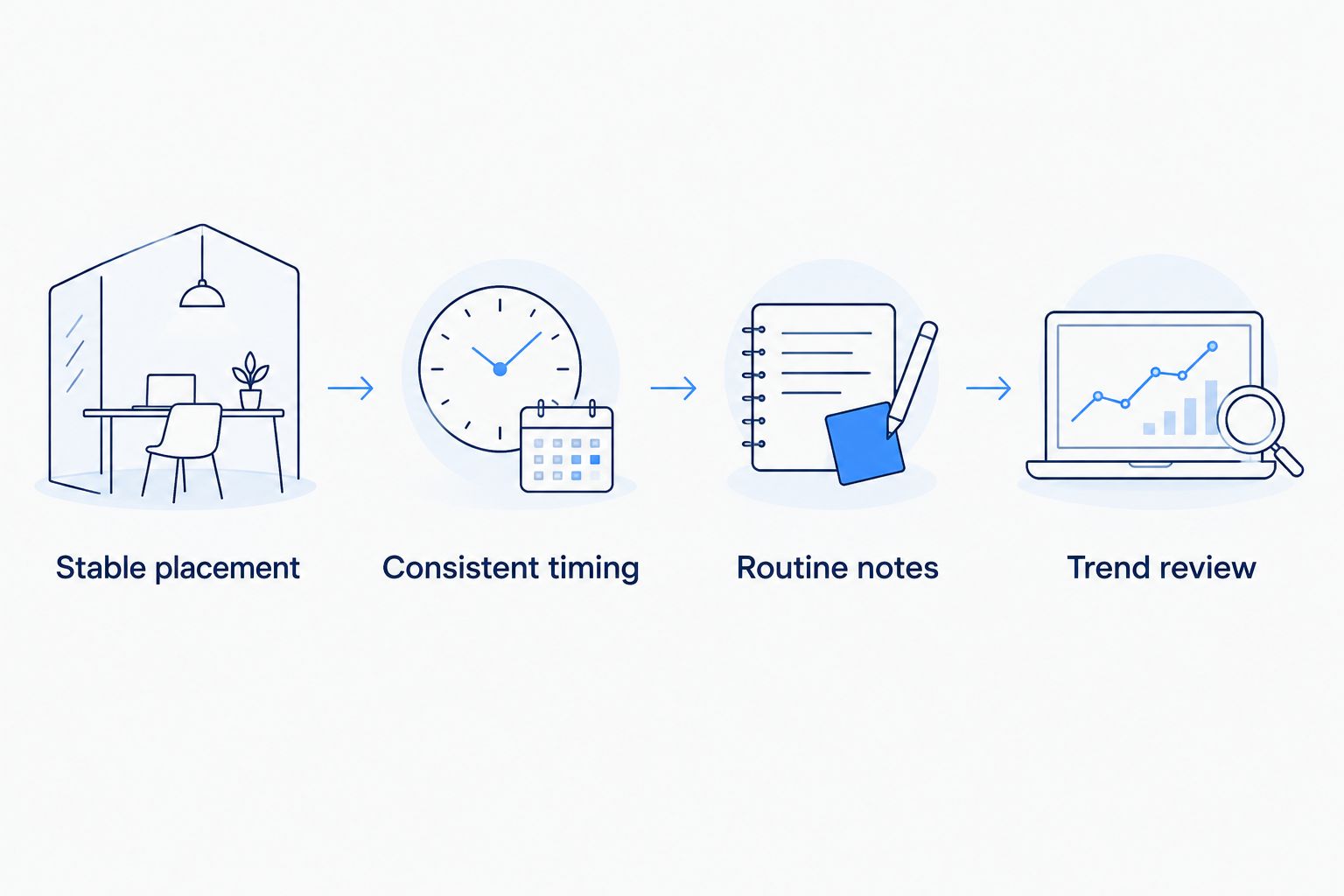
Use this suggested routine for your own tracking:
- Stable placement: Put the scale on a hard, level surface and follow its setup instructions. Avoid changing its location between measurements.
- Consistent timing: Choose a repeatable point in your day. For composition estimates, keep your relationship to meals, exercise, and fluid intake as consistent as practical.
- Routine notes: During an initial 7-day observation period, note unusual circumstances such as travel or a hard workout. Treat this as familiarization, not an accuracy test.
- Trend review: Schedule a review after 4 weeks rather than changing your routine after every reading. This is a suggested review interval, not a promised window for body changes.
If a result surprises you, check the setup and instructions before interpreting it. You can take 2 readings under unchanged conditions to investigate repeatability, but agreement between those readings still does not prove accuracy.
For bioelectrical impedance devices, read the manufacturer's safety instructions before use. If you have an implanted electronic medical device, ask your clinician whether the specific scale is appropriate.
How this ranking was decided
This guide ranks buying approaches by the questions they help you answer: combined habit tracking, weight alone, or standalone composition estimates. It does not assign numerical accuracy scores or present a hands-on comparison.
Hume Health comes first for the combined-tracking use case because its app brings body-composition and wearable insights together, with core tracking included. Weight-only scales report total weight. Foot-only composition scales add impedance-based estimates using foot contacts; Hume Pod 2.0 uses hand-and-foot contacts and does not require a wearable.
The criteria remain the same across all three: measurement evidence, repeatability, understandable metrics, useful trends, and a routine you can maintain.
Which smart scale should you choose?
Choose Hume Pod 2.0 if you want body-composition tracking connected with a broader view of your habits. Keep included core tracking distinct from optional paid coaching and deeper personalized analysis when deciding what you need.
The other categories illustrate different measurement approaches: weight-only models record total weight, while foot-only composition scales add estimates through foot electrodes.
If your deciding requirement in 2026 is independently demonstrated measurement accuracy, prioritize relevant validation evidence over this suitability ranking. No number of app features substitutes for evidence about measurement error.
FAQ
What's the most accurate smart scale in 2026?
This guide does not establish a single accuracy winner. Compare weight accuracy and body-composition estimation separately, using independent validation relevant to the specific model and measurement.
Is Hume Pod 2.0 the best choice for everyday tracking?
Hume Pod 2.0 is a fit for adults who want at-home body-composition tracking connected with broader habit insights. That recommendation concerns its use case, not a proven accuracy advantage over every competing scale.
Can a smart scale measure body fat exactly?
Bioelectrical impedance smart scales estimate body fat rather than measuring it directly. Hydration, measurement conditions, and the device's calculations affect the estimate, so consistent trends are more useful than treating an isolated percentage as exact.
How does a weight-only scale differ from a body-composition scale?
A weight-only scale reports total body weight, while a body-composition scale adds estimates such as body fat and muscle mass. A simpler feature set does not establish greater weight accuracy.
Does Hume Health require a subscription?
Core app tracking does not require a subscription. Premium coaching and deeper personalized analysis are optional paid upgrades.
Do I need Hume Pod 2.0 to use Hume Band 2.0?
No. Hume Band 2.0 works on its own, and Hume Pod 2.0 is optional. Choose based on whether you want wearable insights, body-composition tracking, or both.
Why does my scale's body-fat estimate change between days?
Hydration, recent activity, and measurement conditions can change impedance-based body-fat estimates. Follow the device instructions and compare readings under consistent conditions before interpreting a change as a body-tissue change.
One last thing
A repeatable number can still be wrong. Getting the same reading repeatedly demonstrates consistency under those conditions, not agreement with a reference measurement.
Keep those questions separate when choosing a scale: does it measure accurately, and can you use its information sensibly? The best purchase answers both without asking you to mistake a precise-looking display for proof.